
PS11.1bX: University Chemistry: Entropy and Equilibria
Course Instructor
James G. Anderson, Philip S. Weld Professor of Chemistry, Harvard University
Course Description
Nature is driven by spontaneity — processes that move forward without external intervention. In this course, the second in the University Chemistry MicroBachelors® program, you will build on your learning of thermodynamics by exploring the Second Law of Thermodynamics and an introduction to entropy — representing the unavailability of a system's thermal energy for conversion into mechanical work, often interpreted as the degree of disorder or randomness in the system.
You’ll then apply your understanding of entropy into various thermodynamic systems, gaining insight into equilibria and how entropy changes based on its setting to reach balance. Finally, you will combine enthalpy and entropy into the concept of Gibbs Free Energy, identifying the total amount of energy available in a system or environment.
By the end of the course, you will be able to associate these concepts with the generation of energy, and its impact on the environment by the burning of fossil fuels.
University Chemistry MicroBachelors®
This course is the second of four in the University Chemistry MicroBachelors® program. The courses are designed to be taken in the following sequence, as content in subsequent courses builds on what has been taught in previous ones:
- PS11.1aX: Energy and Thermodynamics: In this course, you will learn the fundamentals of chemistry and energy, from the types of energy to atomic mass and matter to enthalpy and thermodynamics.
- PS11.1bX: Entropy and Equilibria: In this course, you will expand your learning of chemistry and thermodynamics by exploring entropy, free energy, and equilibrium.
- PS11.1cX: Electrochemistry: In this course, you will learn the significance of electrochemistry, understanding how electrical, chemical, and mechanical energy are linked.
- PS11.1dX: Energy to Electrochemistry Final Exam: In this course, you will demonstrate your chemistry knowledge in the proctored final exam.
In order to be eligible for credit, you must complete and pass with a 70% or higher all four program courses. The score required to pass each course and receive a course certificate is 70%.
edX has partnered with Thomas Edison State University, a public university in New Jersey that specializes in adult education, who provides credit for MicroBachelors® programs at no additional cost. Please note, credit for this program is not provided by Harvard University. This program is awarded 8 credits at Thomas Edison State University towards CHE-310, CHE-320, and CHE-330.
In order to redeem your credits please refer to these step-by step directions. Learn more about credit.
Learning outcomes
By the end of this course, you should be able to:
- Determine spontaneity of a process or reaction based on entropy and enthalpy
- Understand how Gibbs free energy relates to other chemistry concepts
- Explore fundamental competition between energy and disorder that determines the state of materials at equilibrium
- Compare and contrast different methods of energy generation and storage
- Explain how different types of renewable energy sources, such as wind and solar, could be used to meet global energy demands
Honor Code
HarvardX requires individuals who enroll in its courses on edX to abide by the terms of the edX honor code. HarvardX will take appropriate corrective action in response to violations of the edX honor code, which may include dismissal from the HarvardX course; revocation of any certificates received for the HarvardX course; or other remedies as circumstances warrant. No refunds will be issued in the case of corrective action for such violations. Enrollees who are taking HarvardX courses as part of another program will also be governed by the academic policies of those programs.
Collaboration
You are welcome to work together on the assessments, but you may not just take a formula and plug in your own numbers. You may also not give away answers (correct or incorrect) to any of the problems. If you aren't sure if something is okay, err on the side of caution and ask for clarification.
Nondiscrimination/Anti-harassment statement
Harvard University and HarvardX are committed to maintaining a safe and healthy educational and work environment in which no member of the community is excluded from participation in, denied the benefits of, or subjected to discrimination or harassment in our program. All members of the HarvardX community are expected to abide by Harvard policies on nondiscrimination, including sexual harassment, and the edX Terms of Service. If you have any questions or concerns, please contact harvardx@harvard.edu and/or report your experience through the edX contact form.
Research
HarvardX pursues the science of learning. When you participate in this course, you will also participate in research about learning. Read our research statement to learn more.
Course Structure
This is a self-paced course. The course is divided into 2 chapters, each of which has 3 parts. The first part of each chapter is the first lecture and accompanying problem set. The second part of each chapter is the second lecture and accompanying problem set. The third part of each chapter is made up of case studies that link the chemical concepts to real-world examples and several of the 50 globally relevant questions (the "50 questions"). Materials for both chapters are accessible to you now and will available until the date listed on the course home page.
Grading
There are four types of graded components in the course:
- Comprehension checks, which follow most videos or readings. Cumulatively, these questions are worth 20% of your final grade. There are 19 sets of comprehension checks in the course, and your lowest 2 scores will be dropped from your final grade.
- Problem sets, which occur at the end of each of the lectures. Cumulatively, the problem sets are worth 45% of your final grade. There are 4 problem sets in the course.
- Case studies, which are found in the third part of each chapter. Cumulatively, the case studies are worth 25% of your final grade. There are 5 case studies in the course, and your lowest score will be dropped from your final grade.
- The 50 Questions, which are found in the third part of each chapter. Cumulatively, the 50 Questions are worth 10% of your final grade. There are 2 sets of 50 Questions in the course.
All other course components are ungraded.
Certification
You must sign up for a Verified Certificate by the deadline listed on the course home page in order to be eligible to earn a certificate.
The comprehension checks, problem sets, case studies, and 50 questions total 100% credit. If you achieve a cumulative score of 70% or greater (out of 100) and sign up for a Verified Certificate before the deadline, you will receive a certificate for the course. When you reach this point, you will see a "Request Certificate" option appear on your Progress page!
Textbook
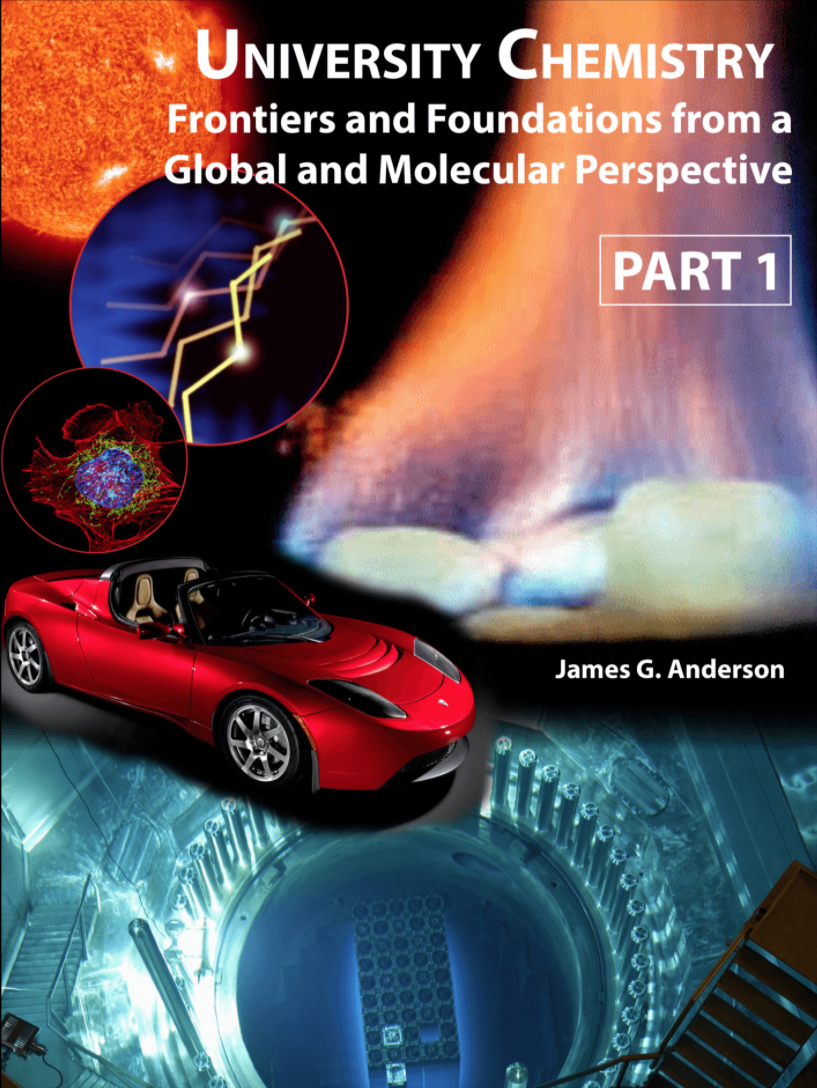
There is an optional textbook available for purchase in pre-print electronic form that covers the content of this course. You may find it useful as a supplement to the content within the edX course.
Course Outline
Chapter 4. Entropy and the Second Law of Thermodynamics
Nature is driven by spontaneous processes, processes that proceed without external intervention. With our advancing understanding of energy, with the insight brought by the First Law of Thermodynamics, and with our ability to track energy transformations from highly organized forms of energy that inexorably cascade to disorganized thermal energy, comes a sharpened recognition that there are other factors that drive spontaneous processes in nature. This constitutes the imperative for understanding entropy.
Chapter 5. Equilibria and Free Energy
A chemical system in equilibrium, \(\rm aA + bB \rightleftharpoons cC + dD\), represents an unchanging combination of macroscopic properties: concentrations, pressure, temperature, etc. There are no apparent changes with time. The equilibrium state thus determines the extent to which a reaction takes place. But at the molecular level, the situation is far different. In this section we quantitatively couple the concept of Gibbs Free Energy with the concept of chemical equilibrium.
FAQs
What is the deadline to sign up for a Verified Certificate?
Check the course home page for the deadline and other important dates.
How do I earn a certificate?
To earn a certificate, you must sign up for a Verified Certificate by the deadline and earn a grade of at least 70%. When you achieve this score, an option will appear on the Progress page to request a certificate. For more information, this link gives more information about receiving and sharing edX certificates. Caution: the grade that you see on your dashboard reflects your grade at that time you requested the certificate. If you complete more assignments to raise your grade, the grade on your Progress page changes, but the grade listed on your dashboard is not updated.
How do I upgrade to a Verified Certificate?
Go to your edX Dashboard (by clicking the edX icon at the top left of this page). Under this course, click the "Challenge Yourself!" link.
How long does the course take?
That is up to you! We expect most learners to move through about 1 part of a chapter each week, for about 6 weeks of learning. But you could move through more quickly or more slowly! Just be aware that the course closes on the date listed on the course home page.
I am doing well on the assessments, but when I look under "Progress" I have a very low grade...why?
The grade is calculated based on all of the assessments you have completed and the assessments that you have not completed (edX says you have a "zero" on those assessments until you have attempted them). You will see your overall grade move up as you progress through the course.