
What to Expect & How to Succeed in this Course
This course is about the future evolution of communication networks towards machine-type applications, i.e. Cyber-Physical Networks. You will learn about the requirements and basic design principles applied to Cyber-Physical Systems and also learn about the future evolution of Cyber-Physical Networks, such as open research problems, but also societal implications.
In this course, you can watch instructional videos, test your own knowledge by taking part in the learning activities, discuss with your fellow course participants in the discussion forum and finally check your understanding in the chapter exams. You find more information about the course activities and the grading of the course below.
If you haven’t taken a course on edX before, we recommend that you take the DemoX course to learn more about taking courses at edX. Later in this text, there is information about what to do if you experience any technical issues regarding this course.
To pass the course/Grading
Verified certificate learners
Learners who pursue a verified certificate will be graded based on completion of the assignments in the Chapter Exams.
To pass the course you have to score at least 70 % of the overall grade which consists of the points that you get from the tasks in the Chapter Exams.
Visit the Progress tab to keep track of your achievements in the course and to get an overview of how the graded tasks are distributed in the course.
Audit learners
For audit learners, no assignments are graded, all assignments in the Chapter Exams can be used as learning activities for you to test your knowledge.
Audit learners will have access to this course for 15 weeks (or until the course end if this happens before the 15 weeks are over) from the time that they first view the course material.
Note: If you decide to change track from the
Effort
We expect that this course will take about 20 hours of work to complete.
Deadline
This course is self-paced which means that all course materials are available from the course start and there are no deadlines for the completion of any course activities, including the Chapter Exams. You choose at what pace you want to take the course and in what order you want to work with the course material, we do, however, recommend that you work with the chapters in order and follow the structure of the course.
However, you need to complete the course before the course ends on the 26th of September 2019, at 9.00 pm/ 21.00 UTC time.
Course Outline
A more detailed presentation of the course content is available in the course Syllabus and a brief overview of the course content is presented in the image below. You are able to navigate between different parts of the course from the 'Course' menu. The course “Cyber-Physical Networks” (CPN) is divided into five chapters. More in-depth information about the contents of each Chapter is presented at the beginning of each Chapter.
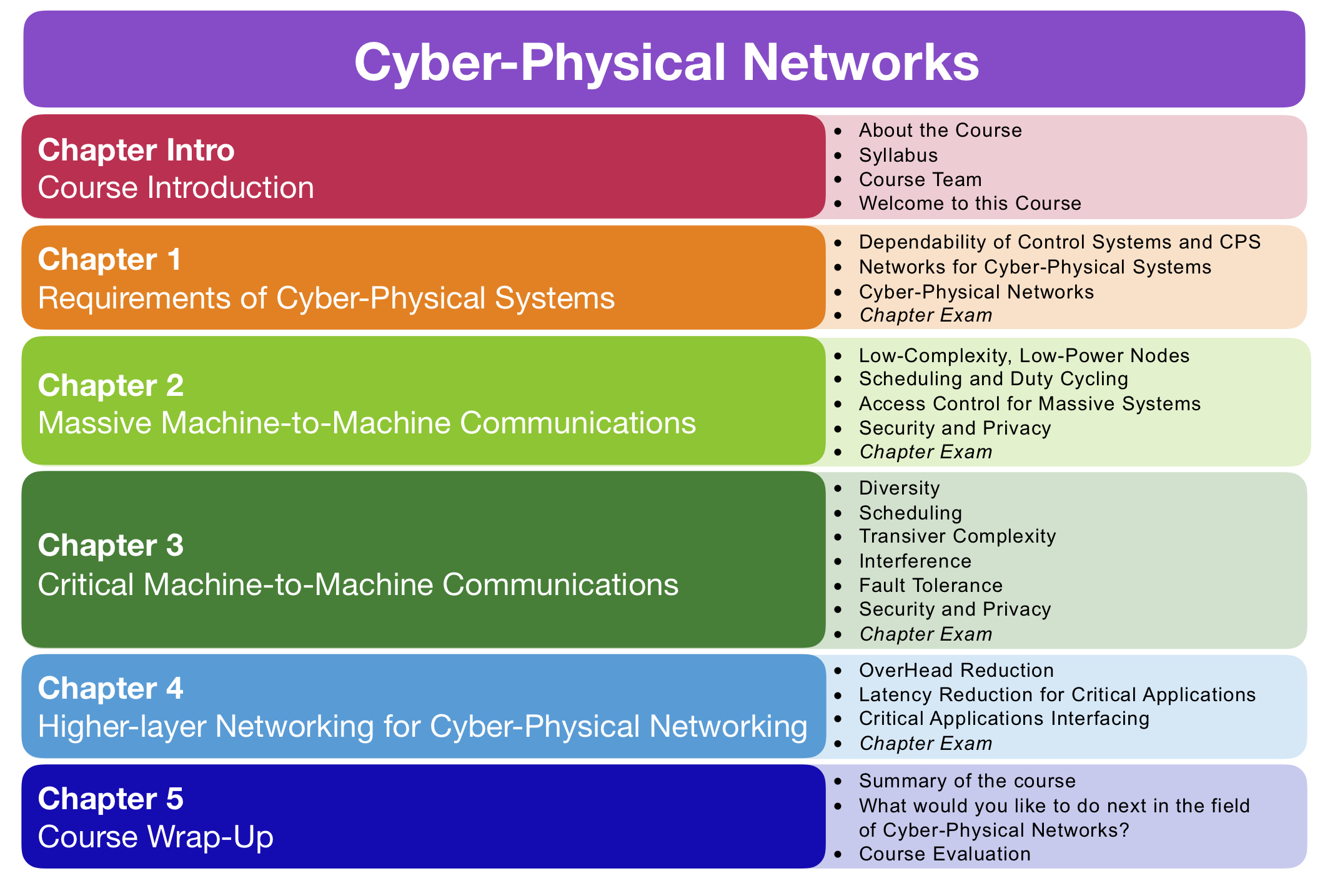
The different Course Activities
The chapters all have a similar structure; we start with an introduction followed by video lectures, Learning Activities, and every chapter ends with a Chapter Exam.
Throughout the course, you will also be encouraged to participate in different discussion threads in the Discussion Forum. You are also welcome to discuss anything that is of interest to you about the course contents with the other course participants in the thread “General”. The Discussion Forum provides you with the opportunity to share information and ideas with people from all around the Globe about the topics of this course and it's a great place for you to ask questions and receive help from other course participants, as well as a place where you can help others. We will also encourage you to reflect on different things throughout the course, for instance, your own progress in the course, and to provide your answers in the Discussion Forum.
In the Video Lectures, Associate Professor Gross introduce the content and explain and exemplify the central course concepts. Video Lectures provide you with valuable information about the topics of this course. While watching the videos, take notes and write down questions that emerge. You can look at the videos as many times you like.
The Learning Activities consist of ungraded tasks designed to allow you to test your own knowledge about the subject matter. The Learning Activities can be answered an unlimited amount of times. The purpose of the Learning Activities is to support your learning and to prepare you for the Chapter Exams. The first Learning Activities after a Video Lecture consist of smaller Quizzes. These are followed by Assignments. The Assignments often require a deeper understanding of the subject at hand than the Quizzes and you are sometimes asked to motivate your answer. In order to give you support when working with the Learning Activities, we have provided some examples of how to solve different problems. You are also very welcome to discuss your difficulties with the other course participants in the Discussion Forum. Just make sure that you follow the edX Honor Code.
Each Chapter ends with a Chapter Exam consisting of graded tasks with a limited amount of attempts, for most tasks you will have two attempts. The tasks in the Chapter Exams contribute to your overall grade in the course.
How to navigate on the edX platform and Technical Support
You will be able to navigate most of the course using a mobile device (smartphone or tablet). Some types of tasks do not, however, work on mobile devices, e.g. the drag and drop tasks. We, therefore, recommend that you carry out these tasks on a computer.
Technical Support
If you need any technical support during the course, please first go to the edX help center or post your question in the Discussion Forum under the thread “Technical Issues”. In the thread “Technical Issues” you will be able to get help from and to help other course participants. If your problem still remains unsolved, please contact
Browsers
We recommend that you use either Firefox or Chrome since the course content might not work correctly on other internet browsers. Make sure that you have the latest version of the browser you're using. More information on browsers.
DemoX
The EdXs Demo course DemoX will show you how to take an EdX course. In this course, you learn how to navigate the platform, get to test different types of tasks and other features and get an insight into how grades work in EdX. If this is your first course on www.edX.org we recommend that you start by taking the Demo Course. In addition, should you have questions about how to navigate the platform, a good idea is to look through the EdX Learners Guide.
Academic Policy
You must behave with academic honesty and respect your fellow course participants. Please abide by the EdX Terms of Service Honor Code.
Teacher Involvement
Given that this is a self-paced online course the teachers will not be involved in discussions, or available for questions.
Courses at KTHx
This is not the only MOOC that KTHx offers. More information about the other courses is available on the page about KTHx on edX, and see the tab About KTH, for more information about KTH, Royal Institute of Technology.