
Syllabus
Please take a moment to review this syllabus. It contains important information about due dates, grading, and academic honesty guidelines.
Images CC-BY Lorc on game-icons.net
Course Map
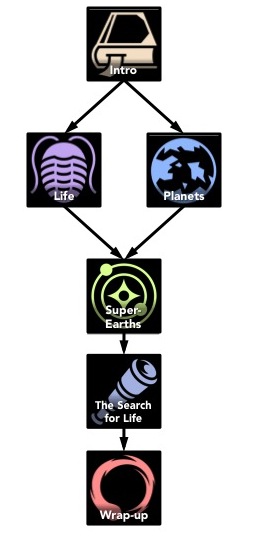
There are six units in this course. You can see the course map to the right. We recommend working through the units in the order shown, and for the "Life" and "Planets" topics, you can complete them in the order of your choice.
Grading
You will be graded on your performance on the questions in this course. These questions are spread throughout the course; there are no exams or quizzes.
Each problem - that is, each time you see the "Submit" box - is worth a number of points as indicated.
Some problems are designed to raise questions in your mind and get you curious about the course material. You should attempt to answer these questions correctly, but they are worth very few points (one or two each), so don't worry too much about them. You can still get an excellent score in the course even if you answer them all wrong.
Other questions are designed to test your understanding of the material in the course. These will be worth more: 10 to 20 points each depending on their difficulty and the length of time it should take to complete them. You will need to complete most of these correctly in order to do well in the course.
There are no due dates until the end of the course. You may complete the material at your own pace, as long as you finish by the end of the course.
Not all students will see the same questions, or see them in the same locations.
Certification
The passing grade for this course is 60%. You can find your current score on the Progress page. All subsections count equally for grading; the lowest score will be dropped. There is no final exam.
EdX provides certificates to those who have passed the course and verified their identity. If you achieve a passing grade in this course you are eligible for a Verified Certificate. Your certificate will indicate you have successfully completed the course, but will not include a specific grade.
You can find out more about self-paced courses and certification at the EdX Learner's Guide.
Guidelines for Collaboration
We encourage class participants to share their approach to problems! Such discussions can be useful for your classmates, and it's always useful to see more than one way to do a problem. All that we ask is that you please do not post solutions. The staff will be proactive in removing posts and replies in the discussion forum that have stepped over the line.
- It is ok to discuss the general approach to solving a problem.
- You can work jointly to come up with the overall approach or general steps for a solution.
- It is ok to get a hint, or several hints for that matter, if you get stuck while solving a problem.
- It is ok to have someone show you a few steps of a solution where you have been stuck for a while, provided of course, you have attempted to solve it yourself without success.
- You should work out the details of the solution yourself.
- It is not ok to take someone else's solution and simply copy the answers from their solution into your checkboxes.
- It is not ok to take someone else's formula and plug in your own numbers to get the answer.
- It is not ok to post answers to a problem.
- It is not ok to look at a full step-by-step solution to a problem.
After you have collaborated with others in generating a correct solution, a good test to see if you were engaged in acceptable collaboration is to make sure that you are able to do the problem on your own.
Contacting Course Staff
Course staff can be contacted on the discussion boards, by creating a new post with the word [STAFF] in the title. Issues will generally be addressed within 72 hours. Please use this for technical matters only, not for questions about the course's science content.
Research
By registering as an online learner in our open online courses, you are also participating in research intended to enhance HarvardX's instructional offerings as well as the quality of learning and related sciences worldwide. In the interest of research, you may be exposed to some variations in the course materials. HarvardX does not use learner data for any purpose beyond the University's stated missions of education and research. For purposes of research, we may share information we collect from online learning activities, including Personally Identifiable Information, with researchers beyond Harvard. However, your Personally Identifiable Information will only be shared as permitted by applicable law, will be limited to what is necessary to perform the research, and will be subject to an agreement to protect the data. We may also share with the public or third parties aggregated information that does not personally identify you. Similarly, any research findings will be reported at the aggregate level and will not expose your personal identity.
Find out more about our research at the HarvardX Research center!