
COURSE OVERVIEW
- Week 1. Introduction to Solar Energy
- Week 2. Working Principle of a Semiconductor Based Solar Cell
- Week 3. Solar Cell Operation, Performance and Design Rules
- Week 4. PV Technology Based on Crystalline Silicon
- Week 5. Thin-Film PV Technologies
- Week 6. Third Generation PV and Other Ways to Utilize Solar Energy
- Week 7. PV Systems - Components and Concepts
- Week 8. PV Systems - Applications and Design
All weeks are available from the start of the course on 15 August 2016, 09:00 UTC.
We have created a .pdf file with a quick overview of all the contents within each block which you can download below:
Weekly Contents of MOOC Solar Energy
PRE-REQUISITES
The course is accessible for a broad range of students doing a BSc program. Some basic knowledge in physics is advantageous and mathematical skills as integration and differentiation are assumed to be known.
DISCUSSIONS & MODERATION
This is a self-paced course, which means that you can enroll and complete it at any time before the deadline (15 August 2018, 23:59 UTC). But this doesn't mean that you're all alone in this course. Many other learners are participating and we encourage you to interact with them in the Discussions, contributing to a positive atmosphere by questioning, sharing and helping out others. The strength of a MOOC lies within you, the community. This is especially true in self-paced courses like this one, so please help each other whenever possible! When participating in the Discussion please take into account the Forum and Collaboration Guidelines.
Due to the nature of this self-paced course, no active moderation and weekly guidance will be provided by the course team. However, the course team will monitor the Discussions and try to answer questions on a daily basis.
GRADING & CERTIFICATION
In order to complete the course, a minimum overall grade of 58/100 is needed. The grading is divided into 5 assignments (40% of the total grade, the assignment with the worst grade will be drop) and 3 midterm exams (60% of the total grade). The assignments are located in weeks 1, 2, 4, 5 and 7, whereas the midterm exams are in weeks 3, 6 and 8.
The deadline for all assignments and exams is 15 August 2018, 23:59 UTC.
If you're interested in a certificate you can upgrade to a Verified Certificate. These certificates will indicate you have successfully completed the course, but will not include a specific grade. Certificates will be issued by edX under the name of DelftX, designating the institution from which the course originated.
Generating an ID verified certificate
If you have enrolled for a verified Certificate of Achievement you can generate your own certificate at any time after you have qualified to pass the course. To qualify for a certificate, you must achieve a total grade of 58% or higher. You can check your grade at any time under the course’s Progress page. An ID verified Certificate of Achievement is available for $50. You can Upgrade on your edX Dashboard to Verified during the course .
To request your certificate, select "Request Certificate" on the Progress Tab. After that, you can download your certificate directly from the Progress Tab, or from your Student Dashboard (look for the Download button next to the name of our course).
For more information on how to generate and download your certificates, explore edX’s documentation on how to generate your certificate. Remember, you have until 15 August 2018, 23:59 UTC to finish all the modules and tests.
Once produced, a certificate cannot be reissued, hence it is very important that you verify the way in which your name appears. Check that, in your edx.org account, your name is correctly spelled, since it will appear on the final certificate. Please note that no Honor Code certificates will be given out by edX for this course.
WORKLOAD
While this is a self-paced course (you can enroll and complete it any time before 15 August 2018, 23:59 UTC), the course is designed to be completed within 8 weeks, if you devote around 8 hours per week to the course.
RESOURCES
This course makes use of the book "Solar Energy, the physics and engineering of photovoltaic conversion technologies and systems" written by the TU Delft staff from the Photovoltaic Material and Devices (PVMD) department published at UIT Cambridge and can be found in the tab The Book above. Note, that you can only find the relevant pages of the book for every corresponding section of the course.
The entire book is available as well. We are happy to announce that the e-book is available for free in the online bookstores. You can order a hard copy as well at the online retailers for typical prices ranging from $25 up to $32.
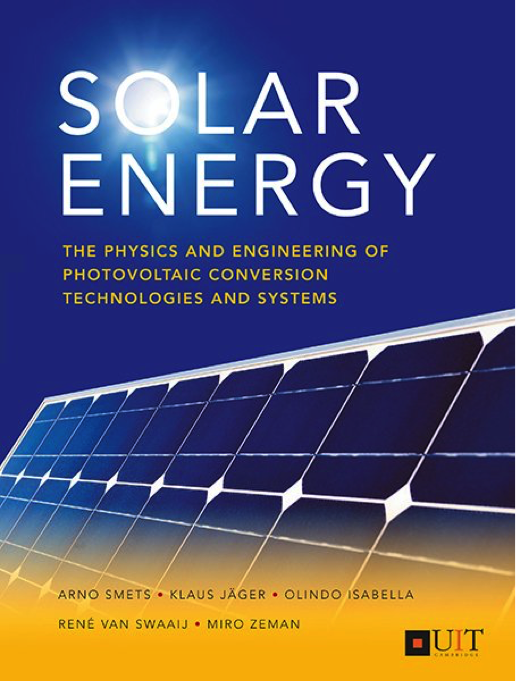
Moreover, you will find plenty of instructional videos each week. These videos (available in 360p, 720p or 1080p) including the subtitles, the transcripts and the slides used can be downloaded through the links below the videos. Additionally, the lecture slides are also made available under the Lecture Slides tab. The corresponding chapters from the book are arranged lecture-wise under The Book tab.
If however you would like to read more about the different topics discussed in this course, we have made a list with a couple of books and websites that you could use as a reference material. Note that this list is by no means complete; there are many more good books about solar energy out there. Also note that these books are not required for this course.
- Jenny Nelson - The Physics of Solar Cells (on solar cells)
- Peter Würfel - Physics of Solar Cells: From Basic Principles to Advanced Concepts (on Solar cells and PV technology)
- Martin A. Green - Solar Cells: Operating Principles, Technology, and System Applications (on solar cells, PV technology and PV systems)
- Donald A. Neamen - Semiconductor Physics And Devices: Basic Principles (Chapters 1-9 & 14, on semiconductor physics)
- Website: pveducation.org (great website with tons of information)
LICENSE
The course materials of this course are Copyright Delft University of Technology and are licensed under a Creative Commons Attribution-NonCommercial-ShareAlike 4.0 Unported License.
The Book "Solar Energy: The physics and engineering of photovoltaic conversion technologies and systems" is excluded from this license and cannot be distributed.
If you choose to reuse or repost DelftX course materials you must give proper attribution to the original TU Delft faculty author(s). Please utilize the following citation "This material was created by or adapted from material posted on the Delftx website, delftx.tudelft.nl, and created by TU Delft faculty member (Name), (Title), (Year). DelftX is not responsible for any changes made to the original materials posted on its website and any such changes are the sole responsibility of [name of user/adapter]."
You must also include a copy of the Creative Commons license used by DelftX, with every copy of the TU Delft materials or the derivative work you create from it.